

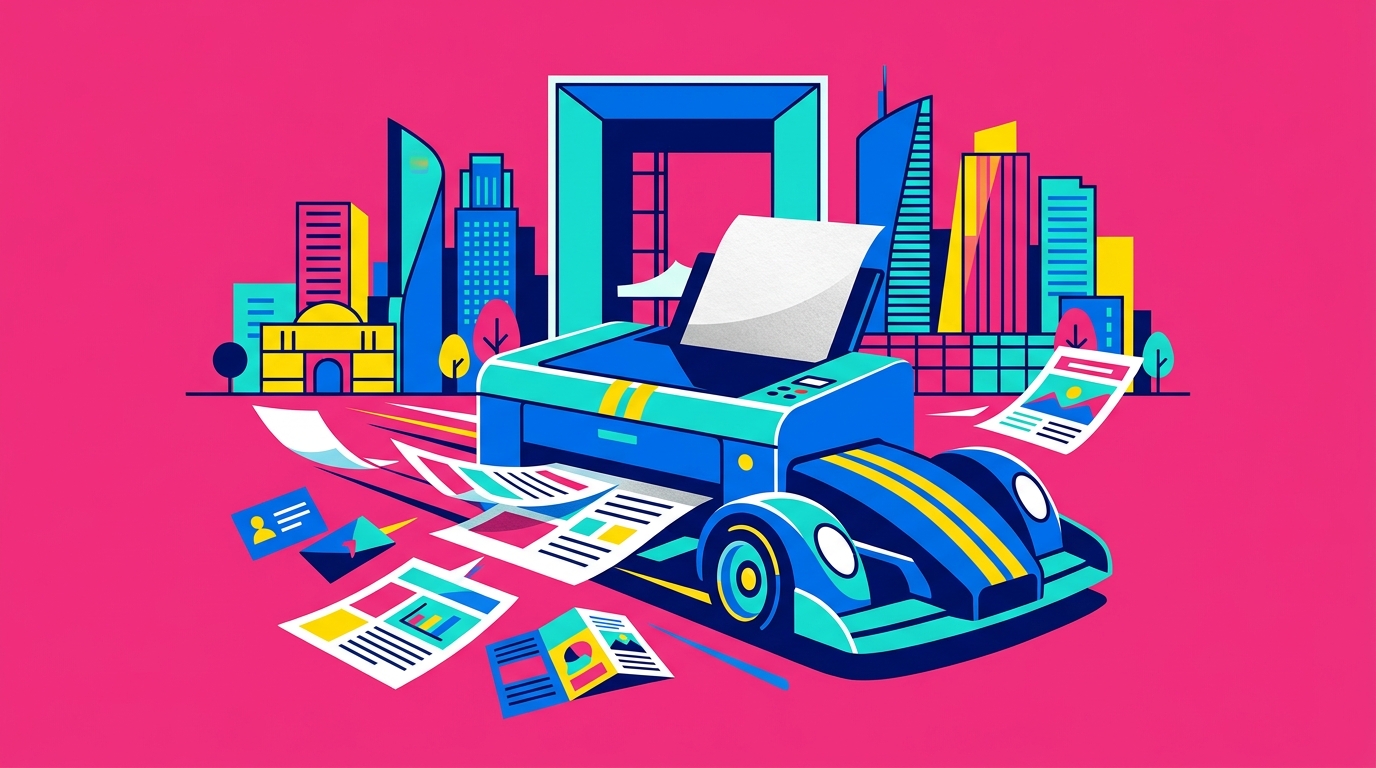
In Nanterre, days are often planned down to the minute. Whether it’s a meeting scheduled the day before for the next day, a trade show in La Défense that moves up its setup, or a store opening that “unexpectedly” happens earlier, print communications don’t have the luxury of waiting. In this context, finding a urgent printing service capable of producing professional media Without compromising on quality, it’s a real safety net. The goal isn’t just to have paper coming out of a machine. The challenge is to achieve a result that’s consistent with the brand image—one that’s ready to be displayed, distributed, posted, or taken to a meeting.
The process is simple: a file arrives—sometimes too late, sometimes not quite ready. You have to check it, make adjustments, and launch a urgent printing, manage finishing touches, and then organize a express delivery or a quick exit. And if possible, avoid that “makeshift booth” look that’s obvious from ten meters away (and, unfortunately, photographs very well). In Nanterre, given its proximity to Paris and business hubs, thefast printing This makes perfect sense: we ensure deadlines are met, maintain quality, and avoid unnecessary travel. The following section details the method, the right tools, and the pitfalls to avoid, based on a simple principle: when time is of the essence, we play it safe.
Rush Printing in Nanterre: Understanding the Real Turnaround Times for Express Printing
When a request comes in “for today,” the first question isn’t “Is it possible?” but “What’s realistic?” A print shop near Nanterre can often produce the essentials in a matter of hours, especially with digital printing. Production starts quickly, without printing plates, and offers great flexibility in terms of quantities. That’s why last-minute commercial printing needs—such as brochures, flyers, or business cards—often turn to digital printing.
For decision-makers, the concept of turnaround time can be broken down into three stages. First, the “file” stage: if the PDF is ready, it’s a breeze. If the document is blurry, has poor CMYK settings, or contains images that are too small, the quality-check process can save—or cost—half a day. Next is “production” time: printing, cutting, folding, binding, and laminating. Finally, there’s “logistics” time: pickup, courier service, or on-site delivery. When planning an event, it’s often this last stage that throws a wrench in the works if no one anticipates it.
To clarify what can actually be done within 24 hours or on the same day, the resource “Printing Turnaround Times in 2026: 24 Hours, 48 Hours, or Same Day” helps distinguish between what’s truly urgent and what’s merely imagined as urgent. A small batch of express flyers, a short run of business cards, an A2 or A1 poster, or a sheetof custom stickers are typically requests that can be handled within very short turnaround times. Conversely, certain print materials require more time when specific finishes, complex die-cuts, or large print runs are involved.
A real-world example: An SME in Nanterre is preparing for a presentation at La Défense. At 4:00 p.m. the day before, the communications manager realizes that personalized name badges and a custom A0-sized poster for the entrance are missing. The name badge file is ready, but the A0 poster requires a final image check. The print shop can produce them on an express basis, and a courier then delivers them directly to the event venue. Everything hinges on the rapid approval of the final proof and on anticipating the delivery location (reception area, badge checker, loading dock). Urgent situations leave no room for approximation, but they reward a simple approach.
This “breaking down the timeline” approach naturally leads to the next topic: choosing the right media—those that produce results quickly while maintaining impeccable quality.
What professional print materials should you choose for urgent printing in Nanterre to ensure credible communication?
In urgent situations, choosing the right medium isn’t just a matter of taste. It’s a strategy: maximizing visual impact while ensuring compatibility with rapid production. The most common requests revolve around the essentials: flyers to attract customers, posters to convey a message, and business cards to ensure you’re remembered. A simple trio, but one that’s incredibly effective when executed well.
For a product launch, an A5 flyer on coated paper—with an eye-catching front and a useful back—can be produced quickly and distributed easily. For a sales meeting, a brochure or leaflet (2-fold, 3-fold) conveys a sense of professionalism. A well-aligned fold and slightly stiffer paper give the presentation a more “premium” feel without breaking the budget. The detail that makes all the difference: safety margins and clear contrast—especially in the lighting typical of a conference room (which is rarely flattering).
When it comes to internal organization, “time-saving” tools are often underestimated. A carbonless copy pad (2, 3, or 4 sheets) eliminates the need to rewrite the same order three times. A clear delivery slip means fewer errors, fewer disputes, and a more relaxed field team. And in urgent situations, these documents are often a top priority because they directly impact revenue. No one wants to lose a sale because of a missing sheet.
In retail and event planning, the demand for point-of-sale (POS) displays is on the rise. A large-format, custom poster catches the eye. An advertising sign on a rigid substrate (PVC, foam board, or Dibond, depending on the application) can guide visitors, put them at ease, and define a path. A clean , professional nameplate on an office or practice door immediately sets the tone: professional, organized, and easy to find (which is already a service in itself).
Storefronts are in a league of their own. A well-applied window decal can transform a space without any construction work. Storefront window decals can advertise a sale, temporarily hide construction work, or create privacy. And since light interacts with transparency, a design that ensures readability from a distance is essential. Here’s a good test: stand five meters away, squint slightly, and check that the message remains clear. If this test fails, so will the passerby.
This overview of custom promotional materials highlights a key point: once a certain level of visibility is reached, large-format printing becomes the priority. That is exactly what the next section covers.
Large-format printing in Nanterre: roll-ups, kakemonos, banners, and photo backdrops for events
When you need to be seen, small formats just aren’t enough anymore. Whether at a trade show, a conference, or a shopping mall promotion, the battle is won from a distance. That’s wherelarge-format printing becomes a valuable ally for teams working under pressure. In Nanterre, quick access to business hubs reinforces this need: a booth must be ready, easy to read, and consistent—even if everything was decided at the last minute.
The go-to tool for urgent situations remains the roll-up banner. An advertising roll-up banner is easy to transport, sets up in a minute, and creates an immediate presence. For express setups, the key considerations are the resolution of the graphics and adherence to the safety margins at the bottom (the mechanism “eats up” part of the graphic). A well-prepared express roll-up banner prevents the classic issue of the logo being cut off right at the bottom (great for testing patience, not so great for convincing a prospect).
The kakemono is often confused with the roll-up, but their uses differ. A hanging kakemono is perfect for catching the eye above a crowd, especially in a hall. It requires a mounting point, so you need to plan ahead for the location, but the impact is clear. With the “kakemono express” version, the key factors are the finish (hems, rods, grommets) and the stability of the stand. A kakemono that sags under the lights is the visual equivalent of a wrinkled shirt at a meeting.
For outdoor use or large spaces, tarps and advertising banners are a sure bet. A custom banner is weather-resistant and visible from a distance. The finish depends on the installation: grommets for attaching, sleeves for sliding a pole through, or tensioning with bungee cords.Printing on tarps can also be useful indoors for quickly covering a wall. It’s an elegant way to hide imperfections: clean, neat, and confident.
For photos and brand communication,large-format photo printing is used to create a “wow” effect without the need for elaborate set design. A wall of images and a photo op help structure a press area, a product launch, or an awards ceremony. The message is simple: something is happening here. And that’s exactly what people love to share on their smartphones.
Following the “same-day” approach, a useful strategy is to print on the same day in Paris, since the Nanterre–Paris workflow faces similar constraints: a ready file, optimized production, and well-organized logistics. When execution is under control, large-format printing becomes a driver of credibility, not an additional source of stress.
After large-format printing, the next question naturally arises: how can you ensure quality when everything is moving quickly, without discovering a problem when unpacking the print?
Rush printing without unpleasant surprises: files, proofs, finishing, and quality control
In an emergency, the risk isn’t “having a medium.” The risk is having a medium that’s unusable. A mistake in a number, a QR code that’s too small, a cut that cuts into the text—and the day gets complicated. The good news: these incidents can be prevented with a simple routine—as long as you stick to it even when the phone is ringing off the hook.
The first hurdle is the file. A properly exported PDF—in CMYK, with bleed and crop marks—makes all the difference. The typography must be embedded or vectorized. The images must be large enough for the final format. For an A0 print, using a photo taken from a screenshot is rarely a good idea (unless the goal is to create a “pixel art” style—but you have to be prepared to own that look). A print shop near me can produce prints quickly, but it can’t invent pixels.
The second safeguard is the final approval. Even with rush jobs, clear approval prevents misunderstandings. It’s helpful to proofread as a client would, not as a designer. A fresh pair of eyes makes all the difference: Is a price easy to read? Is a date correct? Does an address point to the right location? In event projects, even the smallest error is repeated across dozens of copies. That’s the nature of printing: when something’s wrong, it’s wrong across the entire run (and very convincing).
The third key factor is the finish. A business card may look flawless on standard paper, but if the intended use calls for a more “corporate” look, thicker paper or a matte finish can make all the difference. A brochure may require perfect binding or saddle-stitching, depending on the number of pages. A sticker delivered “in sheets” makes it easier to peel off and speeds up application. These are details, but it’s often the details that make all the difference.
Quality also depends on choosing the right medium based on its actual use. An outdoor advertising sign isn’t treated the same way as an indoor display. An illuminated sign involves technical and safety requirements, so it’s rarely compatible with an extremely tight deadline if everything has to be created from scratch—but a temporary wrap can serve as a temporary solution. For a vehicle, a car wrap or even a large custom decal can serve as a quick solution before a full installation scheduled for a later date. The urgent doesn’t preclude the long-term—it makes it possible.
To understand how an express printing service works, reading about the process at an express print shop in Paris is enlightening: consultation, quality control, production, finishing, pickup, or courier delivery. It’s exactly this “no surprises” approach that ensures deadlines are met. The next step is to coordinate pickup or delivery in Nanterre without wasting an hour on unnecessary back-and-forth trips.
Express delivery to Nanterre and fast printing in the Île-de-France region: pickup, courier, and logistics
An express order can go perfectly in the workshop but fall apart at the last minute: delivery. In a professional setting, organizing pickup or express delivery is an integral part of the service. In Nanterre, the advantage is clear: proximity to major routes leading to Paris, Boulogne, Rueil, Puteaux, and La Défense facilitates the flow of traffic. The risk, however, is just as straightforward: schedules, access, safety guidelines, and site-specific constraints (trade show, corporate headquarters, train station, airport).
When choosing between click-and-collect and courier delivery, here’s a helpful rule of thumb: if someone can stop by without interrupting a critical meeting, click-and-collect is quick and convenient. If the team is already “in the middle of a project” or out of the office, courier delivery is a better option. The key is to provide a specific address: site name, building, entrance, floor, contact person, and time slot. A package delivered “to the front desk” without further details sometimes ends up going on a guided tour of an open-plan office. Fun for the package, less so for the schedule.
The budget is managed pragmatically. Many suppliers offer free shipping for orders above a certain minimum amount and provide volume discounts based on quantity. For a procurement team, this presents an opportunity: to intelligently consolidate current needs without overstocking. Express service isn’t the enemy of budget control, as long as the order remains under control. Having a dedicated point of contact on the printing services side also speeds up communication: fewer back-and-forths, greater clarity, and technical decisions approved quickly.
The “Paris print shop” and “Nanterre” aspects often overlap. A project might start in Nanterre, be delivered to a booth in Paris, and then require a restock the next day. In these cases, thinking in terms of “area” rather than “address” simplifies management. Searches such as “print shop nearby” or “print shop around me” reflect a very current need: to reduce lead times and the carbon footprint by minimizing travel. For recurring operations, this approach becomes a real operational advantage.
In cases where the project is handled in Paris, dedicated pages such as “Express Printing in Paris” or the related “Urgent Printing in Boulogne-Billancourt” clearly demonstrate the continuity of service throughout the Île-de-France region. For requests for large-format printing in Paris or printing in Paris, the process remains the same: file ready, quick approval, production, and then seamless delivery.
There’s one last, very practical point: Which media formats really “save the day” for a campaign when time is short? Whether it’s a billboard, an express banner, a 24-hour roll-up, or a 24-hour kakemono, the right choice often depends on the location and the message. The following section focuses on these trade-offs and on the materials that deliver the best return in terms of visibility.
High-visibility custom materials: window decals, in-store displays, packaging, and signage for quick action
When time is of the essence, you need to rely on displays that instantly transform a space. That’s where custom displays really shine: they don’t just provide information—they structure the space and guide the eye. In Nanterre, a retail store, corporate headquarters, showroom, or trade show booth can get a whole new look in just half a day with the right choices.
Window decals are a quick and cost-effective marketing tool. A storefront without a message lets people walk right by. A clear window decal catches their attention. Whether for a grand opening, a promotion, business hours, or a “sale,” window decals grab attention without cluttering the interior. They can be opaque, micro-perforated, or partially transparent, depending on the desired effect. In a professional setting, they also serve to “shield” a space by making what’s happening behind them less visible, without turning the place into a bunker.
Point-of-sale (POS) materials serve another purpose: to drive purchases or prompt action. A counter display, a shelf stopper, an easel, or a pallet wrap—these are formats that guide consumer choice. For a franchise or chain, they’re also a way to standardize execution in the field. A campaign can be approved at headquarters and then quickly rolled out across multiple locations. With well-organized, rapid printing, the rollout becomes synchronized, which enhances the overall impact.
Custom packaging is also gaining traction. Plain packaging gets the job done. Packaging featuring the brand’s colors, on the other hand, extends the experience. For a D2C brand, a restaurant, or a gift set, it serves as a communication tool in its own right. When it comes to express solutions, the idea isn’t necessarily to overhaul the entire packaging process, but to create quick solutions: sealing stickers, printed sleeves, labels, or small runs. A custom sticker can transform a standard box into branded packaging without changing suppliers. It’s simple, and that’s often what saves time.
When it comes to signage, readability is the top priority. A door nameplate, directional signage, an indoor advertising sign, or an area marker at an event prevent repetitive questions and streamline the reception process. And when the reception process runs smoothly, the team can focus on what matters most: welcoming guests, making sales, and winning them over. At a trade show, this is even more true. A visitor who can’t find a booth within two minutes won’t keep looking—they’ll just move on to the next one.
Finally, to boost visibility outdoors or around a retail location, the combination of a poster, an advertising banner, and a storefront display creates a powerful “visibility trio.” And for a vehicle, temporary sticker branding can serve as a mini car wrap while waiting for a full wrap to be installed. The goal remains the same: to be recognized quickly, with a clean, professional finish.
Once the medium is chosen and the logistics are in place, there’s only one thing left to do: initiate, approve, produce, and deliver. Do you have a project? No time to waste—let’s get started!