

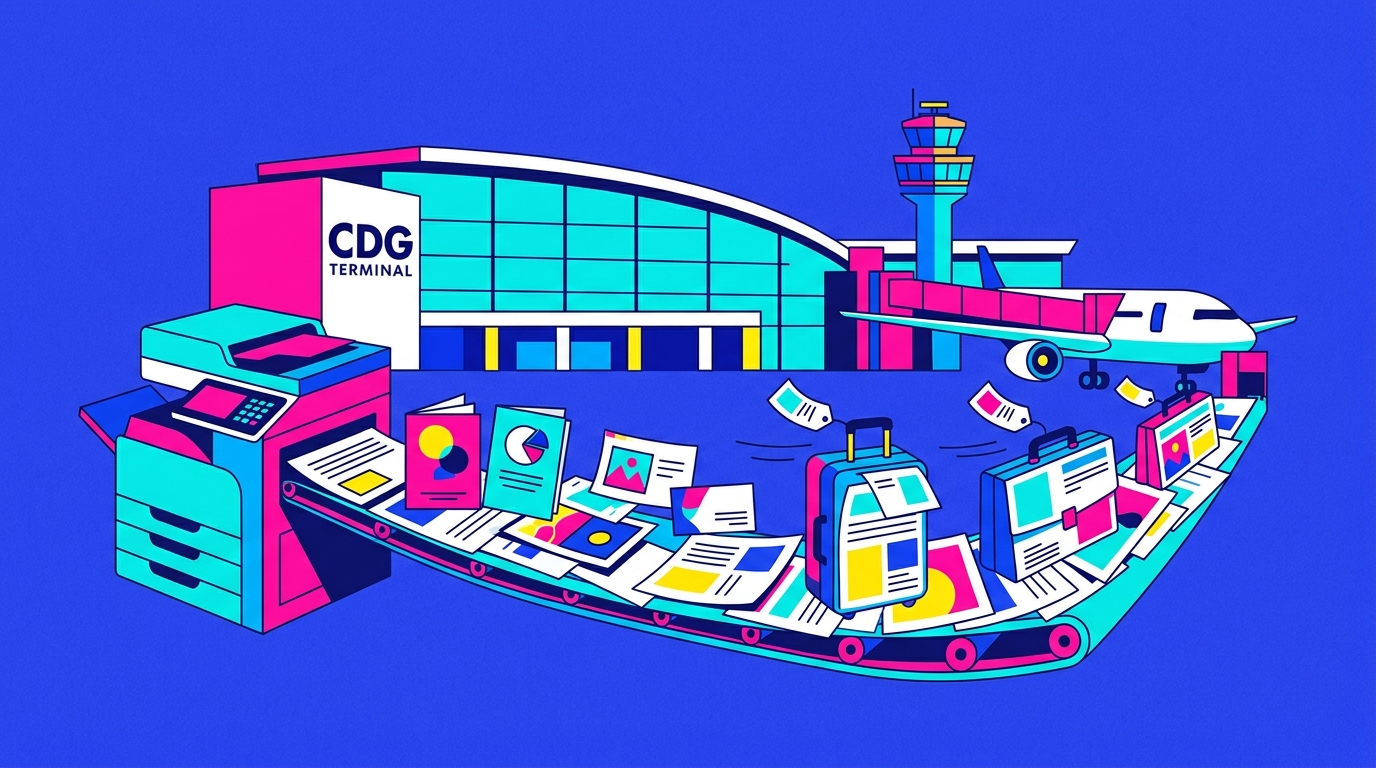
At Roissy, the pressure doesn’t come solely from announcements of departures. When a trade show kicks off tomorrow, a business trip runs longer than expected, or a package “shipped yesterday” decides to go sightseeing, the communications and events teams often find themselves with the same mission: to produce urgent materials that are clean, legible, and consistent with the brand. This is no time to improvise a blurry poster or a flyer that “bleeds” during printing. You need a method, simple technical choices, and a partner capable of producing quickly—without turning the urgency into a gamble.
The sector of Roissy has one advantage: it brings together traffic flows, hotels, business centers, and exhibitors in transit. Therefore, the demand for express printing is consistent, almost systematic. We don’t print “just to look nice”; we print to be visible, credible, and ready to sign. Whether it’s a brochure commercial, a business card last-minute, a roll up advertising for a booth, or a window decal Whether it’s a showcase set up before a launch, the goal remains the same: to ensure the message comes across clearly, even 12 hours before the event. And sometimes, true luxury is simply a finalized proof and a delivery person who shows up on time (yes, they do exist).
Express Printing in Roissy: When a Deadline Calls for a Specific Approach
A printing emergency should be handled like a mini-project. The first step is to define the need, without any unnecessary embellishments: what is the exact location (hotel, exhibition hall, headquarters, store)? What format? What quantity? What is the deadline for delivery? This clarification avoids the classic “we wanted it bigger” situation that comes up when setting up the booth. At Roissy, the timeline is often tied to a shuttle, a team’s arrival, or a setup window. An efficient express printer will therefore work backward: file approval, production, finishing, then pickup or delivery.
The second step is to choose the right material—not “the most premium one in the world.” For urgent documents needed for a meeting, a business card printed on stiff paper with a simple finish may be sufficient. For a trade show booth, a custom large-format poster printed on thick photo paper or a synthetic material is more reliable than paper that’s too thin and warps under the spotlights. And for management that wants “a flawless finish,” a well-executed large-format photo print instantly looks professional, even without a lavish backdrop.
A common thread helps illustrate the trade-offs. Here’s a concrete example: A tech SME, “Novalys,” lands at CDG on a Tuesday evening for a trade show on Wednesday morning. The project manager’s suitcase contains the computers, but not the printed visuals (thanks to the latest logo change). Solution: urgently produce a kakemono (Pay attention to the accent: kakemono), a set of flyer and a nameplate for the front end. With express service, the pitfall isn’t speed—it’s confusion. Just one file exported incorrectly, and everything goes up in smoke. That’s why it’s so important to check everything beforehand: embedded fonts, bleed, and high-resolution images.
In the Paris region, communications teams often search for a nearby print shop or“print shops near me”on their phones between meetings. The goal is clear: to get a quick response, a usable quote, and a realistic turnaround time. To put the term “express” into context, understanding what fast printing really means helps distinguish marketing hype from practical reality. The key insight: urgency is achieved primarily through organization and control of the production process, not through an impromptu rush job at the end of the day.
A well-managed emergency can be recognized by one detail: no one is running around. Everything is organized, approved, and delivered. The next topic, which follows logically, concerns the materials you should prioritize for a trade show or business trip, because not all products are created equal when time is short.
Urgent Marketing Materials Before a Trade Show: Choosing Brochures, Flyers, Posters, and Point-of-Sale Displays Without Making a Mistake
Before a trade show, marketing materials should be selected like a toolkit. A brochure doesn’t serve the same purpose as a flyer, and a poster isn’t a substitute for a point-of-sale display. In short, a common mistake is trying to “do it all” with a single document. The result: an overloaded PDF that’s too small to read from a distance and too dense to flip through while standing. Instead, a trio often works very well: an eye-catching flyer to grab attention, a brochure to convince, and large-format signage to guide visitors.
The express flyer is designed to prompt immediate action: visiting the booth, scanning a QR code, or requesting a demo. It needs to have some breathing room. When printing flyers, paper that’s too thin can give off a “mailbox flyer” vibe—not ideal when the brand is aiming for a premium image. Conversely, paper that’s too thick can sometimes slow down production and finishing. The right balance depends on the turnaround time and quantity, but the goal remains readability from 1 meter away, while on the move, in a noisy hall.
A brochure is a reassuring piece of material. You can read it while sitting down, on a train, or between appointments. For business travel, it needs to fit in a bag without getting damaged. A matte finish minimizes glare in bright light, and a simple binding speeds up production. When speed is the priority, a short, well-structured brochure is better than a 24-page one thrown together hastily. A well-thought-out brochure is like a pitch: you don’t need to shout to be heard.
Custom posters and large-format printed materials serve as standout features. At a booth, a vertical display catches the eye. In a hotel hallway, a larger format can help guide visitors. The key question: where will it be seen? If it’s 5 meters away, you’ll need to make the headlines larger and simplify the message. And if the team wants a high-quality image,large-format photo printing delivers a sharp result—provided the source file is up to par.
Point-of-sale displays help organize the space. A roll-up banner is convenient because it’s easy to transport and quick to set up. A hanging kakemono, on the other hand, looks impressive when hung high, but requires checking the venue’s hanging restrictions. To understand the operational workflow of an express printing service (approval, production, finishing, delivery), the resource “How an Express Print Shop Works” provides a good overview of the steps to follow. Real-world insight: even the best creative work in the world can’t make up for a finish that’s ill-suited to the context.
Once the media have been selected, the crux of the matter remains: on-site visibility, both outdoors and indoors. This is where banners, tarps, signs, and window display solutions come into play—each with very specific installation requirements.
Large-format printing in Roissy: roll-ups, kakemonos, banners, tarps, and photo backdrops
Large-format advertising is the art of being seen without being garish. In the airport area and around the hotels in Roissy, visual competition is fierce: signs, screens, and permanent signage. An “express” roll-up banner must therefore be readable in two seconds. One message, one benefit, one image. Everything else is just noise. For an advertising roll-up intended for a trade show, stability is the top priority: a solid base, a banner that doesn’t warp, and a setup that doesn’t require an engineering degree (even if some models try to make it seem that way).
A kakemono is an excellent choice when floor space is limited. As a hanging kakemono, it catches the eye from a distance, especially in a lobby. However, it requires checking the ceiling height, mounting points, and venue regulations. A kakemono placed in the right spot can drive more traffic without adding a single square meter to your booth. It’s a cost-effective “bonus” when deadlines are tight—provided you have a file with the exact dimensions.
Advertising banners and tarps are the epitome of versatility. A custom banner can be used to cover a barrier, a booth backdrop, or a temporary facade. Outdoors, wind and moisture take a heavy toll. So you’ll need to consider grommets, reinforcements, and sometimes micro-perforation. For an outdoor advertising sign, rigidity and durability matter more than extremely fine details. The goal: to stay in good condition from setup to takedown, even if the weather decides to “play a part.”
The photocall (or photo wall) serves a specific purpose: to create a “branded” photo backdrop for teams, partners, and visitors. In the events industry, it boosts visibility: every photo gets shared on LinkedIn and extends the impact of the trade show. A successful photo booth is set up just like a set: repeated patterns, safety margins, and consistent print quality. Whether you’re getting large-format printing in Paris or near Roissy, the difference often comes down to the finishing touches and assembly, not the visual design itself.
When the booth also needs to provide directions, a directional sign or directional plaque prevents visitors from getting lost. And a lost visitor is a lead that slips away. The right message isn’t necessarily “Hello”; it’s “Demo Area” or “Badge Pickup”—clear and direct. To set realistic deadlines—especially when you’re torn between same-day, 24-hour, or 48-hour options—a page listing printing times (24 hours, 48 hours, or same day ) helps you decide quickly. Final insight: with large-format signage, readability always trumps excessive detail.
Storefront window decals, stickers, and car wraps: making a transit point at Roissy visible
At Roissy, the “passageway” is a valuable resource. You’ll encounter travelers, seminar groups, exhibitors, drivers, and customers in a hurry. To capture their attention, adhesive displays are incredibly effective, as they transform an existing surface into a media platform. A window decal can be used to advertise a special offer, mark a reception area, or conceal a technical area. With express service, the challenge isn’t just printing—it’s ensuring the decal stays in place and is applied properly, with a clean finish that catches the eye right away.
Window decals are chosen based on the desired level of transparency and the intended duration of use. For a short-term campaign around a trade show, an easy-to-remove solution prevents adhesive residue. For a corporate reception area, a more durable window decal reinforces the brand image. And when a venue hosts international visitors, window signage helps guide them without having to set up multiple floor stands. A bit of low-key humor from the field: a poorly applied window decal is like a wrinkled shirt at a meeting… no one mentions it, but everyone has noticed it.
Custom stickers are more versatile than they seem. They can be used to label equipment, “brand” counters, create temporary floor markings, or decorate promotional items. A custom sticker that’s precisely cut and properly laminated is more durable and better able to withstand handling. At a trade show, they’re useful for managing logistics: labeling boxes, providing assembly markers, identifying personalized badges on pouches, or quickly marking a notepad distributed at the booth.
Car wraps are a mobile advertising tool, particularly effective when the team is traveling between hotels, exhibition centers, and clients. A neatly wrapped vehicle acts as a moving billboard. In urgent situations, a partial wrap or specific sections (doors, hood, rear) can be more practical than a full wrap, while still making a strong impact. The key is to follow the curves of the vehicle, anticipate tricky areas, and avoid air bubbles. A “quick-and-dirty” wrap doesn’t save time—it wastes it, because it peels off at the worst possible moment.
These adhesive displays are often combined with physical elements: a temporary lighted sign for a pop-up store, or an indoor directional advertising sign. And while the operational base is in Paris, it’s still possible to coordinate printing in Paris with rapid delivery to Roissy, especially when production needs to be centralized for multiple teams. Final insight: the most cost-effective visibility is the kind that catches the public’s eye without requiring any effort on their part.
Print shops near me: secure files, proofs, finishing, and express delivery
Typing“print shops near me”or“print shops nearby”rarely solves the real problem: ensuring a smooth production process. In rush printing, the process involves four risk areas: the file (export), the proof (approval), finishing (cutting, lamination, assembly), and delivery (time slot, access, contact). When things are moving quickly, these points must be addressed with simple, almost binary questions. The goal isn’t to overcomplicate things, but to avoid silly mistakes.
First, the file. A print-ready PDF must include the fonts, adhere to the final format, account for bleed, and feature sharp images. This is the time to be pragmatic: a web graphic pulled from an old PowerPoint presentation won’t work miracles in large-format printing. A “free” file check isn’t a marketing gimmick—it’s a safeguard. And when multiple decision-makers approve the design, a clear proof prevents any “but I said the other version” complaints on D-Day. The teams that save time are the ones that lock in a final version—period.
Next, the finishing touches. A roll-up banner doesn’t have the same constraints as a poster. A quick-set banner requires sturdy grommets. Custom packaging might seem irrelevant in a rush, and yet: for a press event or a VIP shipment before a trip, simple but well-printed packaging immediately conveys a “professional brand” image. The same logic applies to a business card: a clean, sturdy business card produced quickly is better than a luxurious one delivered after the meeting (it can always be displayed at the museum of missed opportunities).
Delivery is often the blind spot. At Roissy, addresses can be misleading: a hall, a level, a logistics entrance, a hotel with a luggage storage area, or a booth with a site manager. You need a contact person who can be reached and a realistic time slot. For a trade show, the ideal solution is in-person delivery on-site or a pickup coordinated with the setup team. When production takes place in the capital, the search “printing company in Paris” or “Quick Printing in Paris” makes perfect sense if the organization can ensure reliable delivery to CDG. And to define the scope of products that can be produced within 24 hours, the resource Printable materials available on short notice within 24 hours helps you make a decision without wasting an hour going back and forth.
Finally, a word about cross-media consistency. When a brand prints a poster, flyer, brochure, and signage, the color scheme must remain consistent. A good service provider aligns profiles and settings, even on a tight deadline. That’s what prevents the “three different shades of blue” effect at the booth. Final insight: urgency is no excuse for sloppiness—it actually calls for a more rigorous approach.
Do you have a project? No time to waste—let’s get started!