

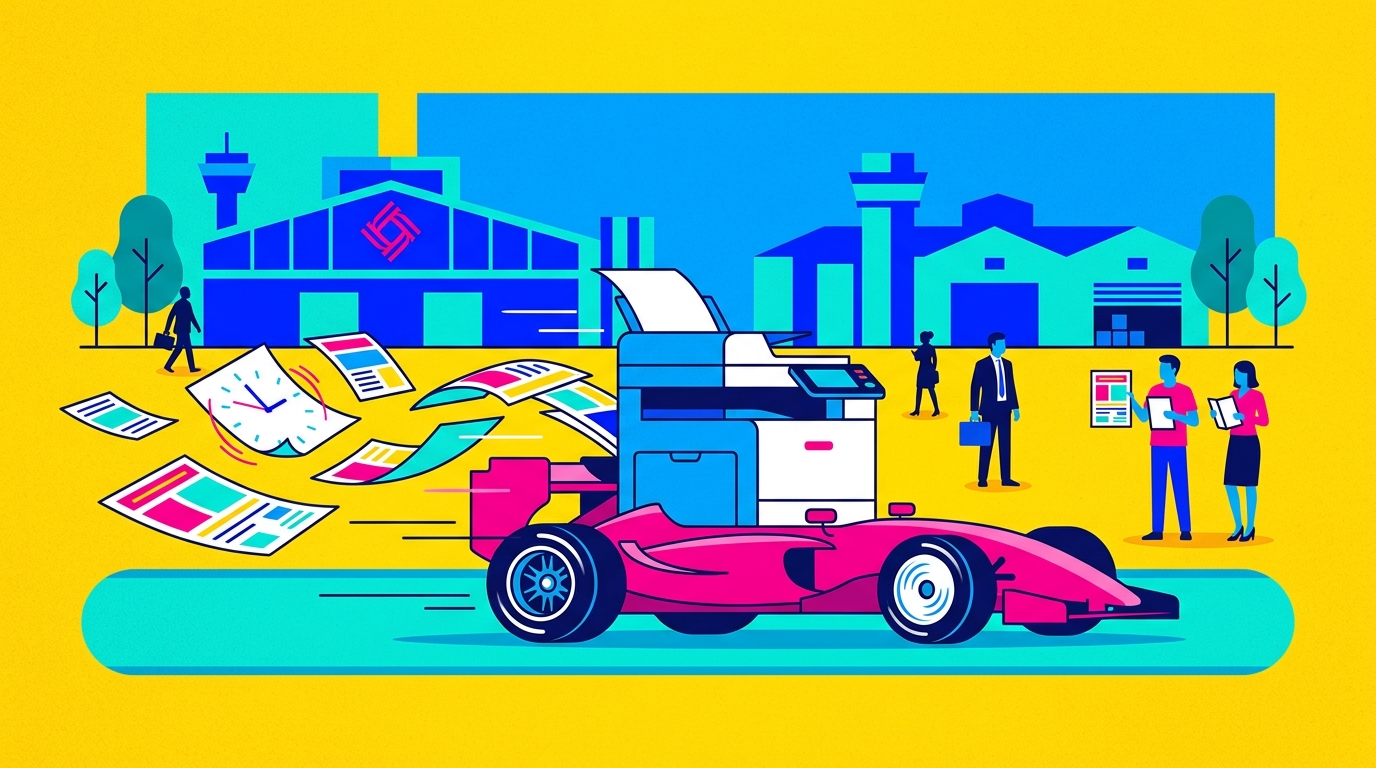
In Rungis, the day doesn’t end when the sun goes down—it ends when the last display is ready to go. Between the National Interest Market, the Silic offices, and the constant flow of traffic to Paris, the events and communications industries operate at a very unique pace. The scene is familiar to the field teams: a trade show that moves up its setup schedule, a booth that changes its message at the last minute, management that approves “now” what was supposed to be approved “yesterday.” At times like these, a express printing service is not a luxury; it is a safety net.
The real challenge isn’t just about producing quickly. It’s about delivering clean, legible, and consistent with your brand—even when deadlines are tight. In Rungis, there are two key benefits: a nearby print shop reduces unnecessary back-and-forth trips, and quick access to major routes to Paris ensures reliable deliveries, installations, and pickups. The result: your urgent materials arrive on time for your events and trade shows—whether they’reposters, flyers, a corporate brochure, a backup business card, or a roll-up banner ready to be unfurled (without any drama—that’s better).
Express Printing in Rungis: Find a Reliable, Open Printing Shop Near Me
When a search starts with “printing shops near me,” the need is rarely just theoretical. There’s a deadline, a delivery requirement, a trade show about to open, or an executive meeting where the brochure needs to be on the table. In Rungis, the location helps: between the Marché d’Intérêt National, the Silic zone, Le Sud, Rungis Ville, and Les Antes, several providers offer services geared toward short turnaround times. The best approach is to choose a partner capable of handling the urgency without compromising color accuracy, precision in cutting, or the durability of the finishes.
The first step is purely practical: opening hours. Some print shops have extended hours, sometimes on weekends and, in rare cases, on holidays. Before heading out, a quick call prevents a wasted trip and helps clarify the details: format, quantity, file, finishing, pickup, or delivery. This simple approach reduces stress and speeds up the start of production. It’s also where you can gauge the level of service: a printer who asks the right questions helps ensure your deadline is met.
In practice, the most common requests involveflyer printing for quick distribution,business card printing to equip a sales team,custom posters for store windows or in-store promotions, andlarge-format printing for trade show booth materials. At this stage, the print shop becomes a mini control tower: receiving files, checking them, starting the print run, finishing, packaging, and then either pickup via click-and-collect or shipment via express delivery.
A common scenario clearly illustrates the value of Rungis. An SME is exhibiting at Porte de Versailles the next morning. The promotional message changes at 6 p.m. The visuals are ready, but they need to reprint the posters and a advertising roll-up. By going through a print shop nearby From Rungis, the process is streamlined: file submission, approval of a proof, rapid production, then shipment to Paris. The benefit isn’t just measured in minutes, but in peace of mind: the booth opens with the right prices and the right wording. Key takeaway: Proximity isn’t just about getting there quickly—it’s also about safety..
Urgent Materials for Trade Shows: Which Formats to Print on a Rush Without Sacrificing Quality
For trade shows, urgency isn’t just about “printing something.” You need to print the right material, in the right format, with the right finish, so that it stands upright, is visible from a distance, and can withstand a full day of handling. The classic trio remains effective: flyers for lead generation, posters for visibility, and in-store displays to guide the visitor journey. With express printing, the goal is to choose realistic options that can be produced quickly, without overcomplicating things.
At a booth, a kakemono often makes all the difference: it adds height and catches the eye immediately. Depending on the setup, a hanging kakemono works very well if the trade show allows it, while a roll-up banner remains the “30-second setup” solution. The express roll-up is particularly useful when the team arrives late for setup: no tools are needed, just a flat surface and a little optimism. For photo and partnership areas, the photocall serves as both a branding tool and a social media tool: it boosts organic visibility without feeling forced.
In large-format printing, the choice of material is key. A vinyl banner or advertising banner is suitable for booth structures, with grommets and reinforcements as needed. A custom banner can also serve as a backdrop during a speech. For walls and partitions, we switch to laminated panels, which are stiffer. For outdoor use, an outdoor advertising panel requires a material that can withstand wind, moisture, and UV rays—even if the event lasts “only” two days.
The small format, meanwhile, remains the lifeblood of the business. A business card may not seem like much—until the team runs out of them. In a pinch, a 24-hour business card or an express business card saves the day. The same logic applies to a branded notepad or a product brochure: at a trade show, paper still holds the most weight. We scroll a lot, but we often reread what we carry in our bags (the mystery of human psychology).
To see concrete examples of materials that can be produced on short notice, the “24-Hour Rush Print Materials” page helps clarify what can actually be produced through express production. Final insight: At a trade show, the right promotional material is one that stands out, is easy to transport, and can be set up without any hassle.
Speed doesn’t get in the way of a systematic approach—in fact, it’s quite the opposite. The next step is to finalize the files, colors, and finishes to avoid any “unpleasant surprises” at 7 a.m., when everyone’s already a cup of coffee behind schedule.
Fast printing and zero unpleasant surprises: a method for checking files, proofs, and finishes
A tight deadline leaves no room for approximations. The typical mistake isn’t a finicky machine—it’s a poorly prepared file. An RGB image that shifts in print, an unembedded font, missing bleed, or an image that’s too low-resolution for large-format printing. In rush jobs, these details become pitfalls that cause delays. The right approach is to establish a simple, systematic routine that protects the schedule without complicating things for the teams.
First step: prepress checks. Before launching aposter campaign or a quick flyer print run, you need to verify the final dimensions, safety margins, bleed areas, and resolution. For customized printing, you also need to validate the variable fields if multiple versions exist. A retail campaign involving ten stores shouldn’t end up with the right price… in the wrong city. This isn’t a joke—it’s already happened to more than one retailer.
Second building block: the proof, even an express one. A proof isn’t an administrative luxury. It’s a deliberate, brief pause that prevents you from rushing into production… only to end up with an error. It can be digital to save time, with clear validation of critical elements: spelling, phone numbers, QR codes, dates, and legal notices. For materials intended for professionals at trade shows, an incorrect date or a mislabeled booth can cost you credibility.
Third component: finishing and binding. A brochure can be wire-stitched for speed, or perfect-bound if the document needs to last. A flyer can be simply trimmed, or laminated if it will be distributed on a large scale. A custom sticker requires a clean cut, especially if it’s part of a series intended for custom packaging. When it comes to window decals, the quality of the cut and the application orientation (inside/outside) are just as important as the printing itself.
In Rungis, many print shops have a “reprinting/digital/post-press” culture focused on short turnaround times, offering binding, cutting, lamination, and finishing options. To get an idea of how a fast-turnaround production line is organized in the Paris/IDF area, the resource “How an Express Print Shop in Paris Works” explains in simple terms the steps that are often behind the scenes. Final insight: reliable express service is a series of micro-checks, not a blind rush.
Large-format printing in Rungis: roll-ups, kakemonos, banners, and billboards designed to be visible from a distance
When the goal is to be seen from ten meters away, large-format signage becomes your best ally—provided you choose the right product. A roll-up banner works very well for a single message, a product launch, or a strong promise. A kakemono, on the other hand, allows you to prioritize information and create a more premium look. For large spaces, banners and advertising banners create an immediate impact, especially if they’re placed high up or at the back of a booth.
The question of material comes up often. A standard backdrop is versatile. A higher-quality version prevents glare from spotlights. For a trade show, a “gray-backed” material can reduce transparency if the backdrop is placed in front of a light source. For a photocall, flatness is key: a surface that’s too flexible will wrinkle, and your photos will quickly look like a well-worn theater set. In real life, the difference shows up in the images shared after the event—and thus in your brand’s image.
For outdoor use, a billboard or outdoor advertising sign requires a more robust approach. Mounting hardware, thickness, rigidity, and durability: all these factors are determined based on the duration of exposure and installation constraints. A temporary sign for a three-day event does not have the same requirements as construction site signage. The same logic applies to nameplates: indoors, appearance is paramount; outdoors, durability becomes non-negotiable.
Storefronts are a special case, very common in business districts. A storefront window decal is used to advertise a sale, direct customers to an entrance, or conceal an area under construction. The decal can be micro-perforated to let light through, or opaque to block the view. The critical part is the installation: air bubbles, alignment, and seams. For rush jobs, it’s best to allow extra time for a clean application, especially if the surface is large.
And then there are “mobile” advertising mediums. Car wraps transform a vehicle into an advertising medium, which is very useful for franchisees and networks. When it comes to events, a team that arrives on-site with its own branding sends a clear message: organization, professionalism, and consistency. It’s subtle, but it makes an impression.
To meet a tight production deadline, understanding print turnaround times—24 hours, 48 hours, or same-day— helps strike a balance between ambition and reality. Final insight: With large-format prints, visibility depends as much on the substrate as it does on the finish and installation.
Most urgent projects aren’t just handled in the workshop. They also depend on logistics: pickup, delivery, installation, and coordination with event venues in the Île-de-France region.
Paris Printing, Large-Format Printing in Paris and Rungis: Organizing Express Delivery and Seamless Installation
Rungis is strategically located to serve southern Paris and the Île-de-France region. For event teams, this offers a tangible advantage: quick access to major highways, proximity to numerous exhibition venues, and the ability to combine workshop pickup with delivery. When a request involvesprinting in Paris orlarge-format printing in Paris, the question isn’t just “where to print,” but “how to get the materials to the right place, at the right time, and in the right condition.”
Logistics starts with packaging. A roll-up banner must be transported in its carrying case; otherwise, it will end up with a damaged corner (and a damaged corner is a corner that everyone notices—it’s a universal law). A banner must be rolled up the right way to avoid creases, especially if it’s fresh off the press and heading straight to installation. Rigid signs require corner protection and padding. This attention to detail isn’t perfectionism—it’s what ensures your signage remains presentable on-site.
Next comes coordination with the venue. Trade shows have specific delivery windows and access requirements. Hotels, corporate headquarters, and shopping centers have their own rules. A printer with experience in the events industry anticipates these constraints, offers realistic timelines, and minimizes surprises. The service may include installation, which is useful for window decals, nameplates, or temporary directional signage. The idea is simple: you delegate the part that’s costly if it goes wrong.
In practice, the materials in question go beyond large-format items. A sales team may need personalized name tags at the last minute—to replace forgotten ones or to accommodate a guest. A brand may request express custom packaging for a press mailing, or a smallreprint runof flyers for a local promotion. Within a chain, a lighted sign or a setof custom posters may also become urgent as a grand opening approaches. Speed is important, but brand-retail alignment is just as crucial.
For projects centered on the capital, the pages dedicated to express printingin Paris andsame-day printing in Paris clarify the options when you’re looking for a Paris-based print shop while relying on a convenient production or pickup location. Final insight: true express service is when production, shipping, and installation move forward as a single, coordinated process.
Express marketing materials for professionals: business cards, brochures, stickers, window decals, and last-minute point-of-sale displays
The most common emergencies aren’t always dramatic. They happen every day, and they directly impact business efficiency. A missing business card, an outdated brochure, a flyer that needs to be reprinted because a price has changed, or a poster to put in the window to announce a promotion. For professionals, these materials are conversion tools. When they’re missing, the team makes do as best they can, often with solutions that result in missed opportunities.
The express business card remains a classic, especially for newcomers, sales representatives, and franchisees. The choice of paper and finish influences how the card is perceived, even when speed is the priority. Thicker paper, a clean cut, and a soft-touch lamination: these are small details that prevent the card from looking like it was “printed in a hurry.” And when putting together a kit, a personalized name badge is a natural addition, especially for teams at trade shows or corporate events.
For retail locations, in-store promotional materials are the centerpiece of the “last meter.” Counter displays, shelf stoppers, small posters, and signs: what matters most is visual consistency and readability. In a nutshell, it’s best to focus on a simple message and a clear hierarchy. A well-designed, customized poster often outperforms an overloaded visual. The human eye doesn’t have unlimited processing power—especially on a Saturday afternoon.
Storefronts deserve special attention. A storefront window decal can be used to announce a promotion, display hours of operation, or guide the customer journey. A custom sticker can round out the look—on a door or counter—to highlight an offer or a promise. For products,custom stickers play a crucial role in identification, traceability, and branding. And when time is of the essence for packaging, custom packaging becomes a key asset for product launches, press kits, or flash sales.
When it comes to events, needs may extend to more visible formats: kakemono, roll-up banners, custom banners, or even temporary billboards. Sometimes a brand may also request a large-format photo print for an internal photo wall, a tribute, or a showroom display. The key is to define the intended use: duration, viewing distance, lighting, and transportation constraints. A quick decision, yes—but an informed one.
To understand the “safety net” approach and our deadline-driven service philosophy, the “Discover the Team and Our Method” page offers a glimpse into an organization designed for controlled urgency. When the need arises, the most effective approach is to quickly get things on track by reaching out to us to confirm files, quantities, finishes, and the schedule. Do you have a project? No time to waste—let’s get started!