

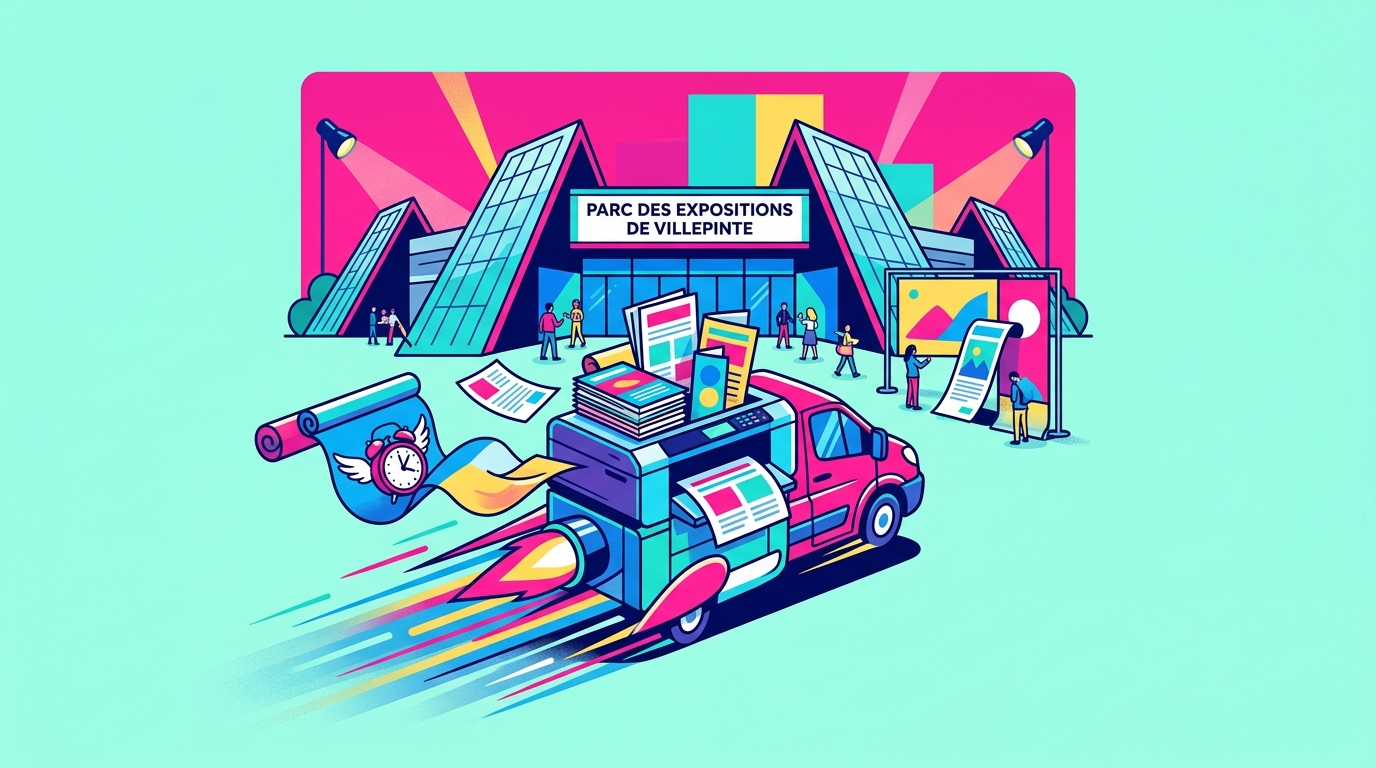
At Paris Nord Villepinte, setup days have a very distinctive feel: new carpet, beeping badges, boxes everywhere… and that little rush of adrenaline when a detail is missing. An advertising roll-up left at headquarters, a custom poster approved too late, an advertising banner that ultimately needs to display a different price. In moments like these, the goal is simple: to have an express printer capable of producing clean, legible trade show materials and getting them delivered before the show opens—without turning the setup into a series of disasters.
The setting helps: Villepinte is located north of Paris, just a stone’s throw from CDG Airport, with access to the RER B line and major highways. In other words, it’s the perfect playground for a fast delivery on-site, provided you have a well-oiled process in place: file review, proof approval, printing, finishing, and then a courier with the right logistical access. The trade shows held there demand a fast pace and strict compliance requirements that leave no room for a “we’ll figure it out when we get there” approach. Here, a service thatexpress printing It’s not a luxury—it’s a safety net for the communications, procurement, and events teams, the ones who have to make the brand shine while the clock never stops ticking.
Express Printing in Villepinte: Get Your Trade Show Materials Ready Before the Show Opens
A booth that opens on time is rarely a matter of luck. It’s the result of a series of well-made micro-decisions, particularly regarding event materials. In Villepinte, the window of opportunity is short: setup, checks, final adjustments, then the flow of visitors. An express printer must therefore work like an orchestra conductor: every step must be spot-on, or else chaos ensues (and chaos doesn’t print in full color).
The first hurdle is the files. A brochure or flyer may seem simple, but a margin that’s too narrow, missing bleed, or black rendered in RGB can ruin the final result. For rush jobs, ensuring “zero unpleasant surprises” requires a systematic check of dimensions, trim lines, overprints, color profile, and resolution. When deadlines are tight, a clear proof is your best safeguard. And yes, when the team is international, a proof in French or English prevents last-minute misunderstandings.
Next comes the trade-off between quality, turnaround time, and budget. A poster in a hallway doesn’t have the same constraints as a premium display on a counter. For urgent flyer printing, the right choice of paper and a clean cut already make all the difference. For business card printing, a soft-touch matte finish can look stunning… but if it jeopardizes the schedule, a well-calibrated modern coated finish can save the day. The right choice isn’t “the most luxurious”—it’s “the most appropriate” for your goal and timeline.
The venue also has its own rules. The halls at Paris Nord Villepinte are numbered 1 through 7, with visitor entrances, rear loading docks, press areas, and sometimes VIP routes. A successful, timely delivery depends as much on GPS as it does on the information provided: hall, booth number, name of the on-site contact, and setup time slot. Without these three elements, even the best courier will end up playing hide-and-seek with your booth.
A typical scenario illustrates this process well. An SME arrives the day before a major trade show with a graphic design that was approved late, because headquarters changed the sales pitch two days before the event. They need to produce a custom poster, a kakemono (and sometimes a hanging kakemono if the booth height allows), plus a set of custom badges for the team. If the files are in order, the print shop can startthe custom printing and then apply the finishing touches (eyelets, sleeves, lamination) while the logistics team prepares the shipment for the courier. It is this seamless workflow that ensures the event opens on schedule.
To get a sense of what’s realistic with express service, here’s a helpful guide: 24-hour, 48-hour, or same-day turnaround times. A reliable schedule goes a long way toward reducing stress.
A simple insight: in Villepinte, it’s not the largest print item that causes problems—it’s the one that’s missing at the wrong time.
What promotional materials should be printed urgently for a booth at Paris Nord Villepinte?
When trade show preparations pick up speed, the question isn’t “What can we print?” but “What will have the greatest impact on-site?” Advertising materials fall into three categories: attract, guide, and convert. A good last-minute strategy is to address all three of these needs without spreading yourself too thin.
When it comes to attracting attention, large-format displays are still the way to go. A well-designed large-format print creates a visual focal point amid competing booths. The classic duo: roll-up (or promotional roll-up) + kakemono. The roll-up is reassuring because it sets up in 30 seconds, even when the caffeine has worn off. The kakemono, on the other hand, offers an elegant vertical presence, especially when used in a series (three visuals = a mini-wall of messaging). For a “wow” effect, the photo booth and the image wall add depth, which is useful for press photos or social media posts.
By providing direction, signage saves everyone time. A nameplate at the reception desk, an arrow on the floor, a “demo” sign—these are the details that keep traffic moving smoothly. For outdoor areas or high-traffic zones, an advertising sign can be adapted for outdoor use if the location requires it. At a trade show, wayfinding is a service provided to visitors… and a service provided to your sales team, who don’t want to have to repeat a hundred times where the demo is located.
When it comes to converting leads, small-format materials are still essential. A well-structured brochure, a brief promotional flyer, and a polished business card: this trio turns a conversation into a real follow-up. Here, perceived quality matters. A business card that’s too flimsy often gets forgotten, whereas one printed on sturdier paper conveys the image of a serious brand. And if the team needs to take notes, a personalized notebook or notepad can become a “useful giveaway” (that rare item that doesn’t end up at the bottom of a tote bag—a subtle but real achievement).
Point-of-sale ( POS ) materials round out the display. A counter display, a shelf stopper designed for a demonstration display case, a display stand—anything that frames the message and prevents your products from “speaking for themselves.” For brands showcasing product lines, custom packaging can also be produced on short notice in small batches to ensure a consistent look during the trade show, even if that means launching a larger production run afterward.
Glass surfaces deserve special attention. Window decals—and especially those used on storefronts—are highly effective for defining a space, creating privacy, or displaying a promotion without cluttering the area. A clean installation makes all the difference: an air bubble on a premium graphic is like a stain on a white shirt during a client meeting.
Finally, certain materials serve as a smart “Plan B.” A custom tarp or banner can hide a damaged partition, correct a branding error, or create a uniform background. And when an event takes place outdoors or between two halls, an advertising banner becomes a highly cost-effective form of mobile signage.
To explore which formats can actually be printed on short notice, this resource helps narrow down the possibilities: materials that can be printed within 24 hours. An effective rush order starts with a clear scope.
A useful insight: at trade shows, the most cost-effective printed material is often the one that saves visitors from having to ask a question.
Once the visual impact is established, the real challenge then lies in logistics and access, especially at Villepinte.
Fast delivery to Villepinte: courier, exhibition hall, setup, and no detours
A fast delivery to an exhibition center is not the same as an office delivery. Access points vary, logistics badges have their own rules, and timing is sometimes down to the hour. To succeed, you have to treat the delivery as an integral part of the service, not as “the final step.”
The first point is providing the correct address. “Paris Nord Villepinte” isn’t enough. You need the hall, the booth number, and a contact person who can be reached. When these three pieces of information are included in the quote from the start, the courier won’t end up at the visitor entrance with a 3-meter tarp under his arm, asking where the booth is. Everyone saves time, and the stress stays locked away in a box, tightly sealed.
The second point is packaging. A roll-up banner must be transported in its carrying case, a poster must be protected, and a large-format photo print may require a rigid tube or reinforced cardboard. For a photocall or a large banner, the packaging must allow for quick handling during unloading. The setup crews work quickly; if it takes ten minutes to open a package, that’s already too long.
The third point is the “delivery time.” During setup, the loading docks are more accessible, but activity is heavy. Afterward, scheduling deliveries can become complicated. A well-organized service often offers several options: drop-off at the booth during setup, drop-off at the exhibitor reception desk, delivery to the hotel if the team isn’t on site yet, or click-and-collect pickup at the workshop. This flexibility turns a constraint into an option.
A common scenario in Villepinte: an agency manages multiple booths and needs to distribute materials. On Monday, a brochure is sent to Hall 5, a set ofcustom stickers is sent to Hall 6, and a banner needs to be delivered to an event area. Without a system in place, it turns into a treasure hunt. With clearly labeled packages, a clear schedule, and a dedicated point of contact, the same operation runs smoothly.
Installation is the other logistical aspect. Whether it’s a window decal or a car wrap on a display vehicle, large-scale signage, or a video wall: if installation is planned, it must be coordinated. Quick installation requires not only a well-printed material but also one designed with installation in mind: safety margins, reading direction, alignment marks, and sometimes lamination to facilitate application. A good service provider won’t let you discover on-site that the material is 2 cm short of covering the entire area.
For “need it today” requests, here’s a useful framework: same-day printing in Paris. Villepinte benefits from this proximity, provided that shipping and production are managed as a single system.
A key insight to keep in mind: a successful express delivery begins the moment you send the PDF, not when the courier sets out.
Large-format printing and signage: roll-ups, kakemonos, banners, and window decals to be seen from a distance
At a trade show, visibility comes down to a matter of seconds. A visitor walks by, takes a quick look, and makes a decision.Large-format printing and signage therefore have a simple role: to make your message legible, credible, and memorable—even when the exhibition hall is as busy as a beehive. Large-format printing isn’t “just big”; it’s a tool for guiding the mind.
A roll-up is often the first thing that comes to mind—and for good reason. It’s compact, portable, and can be placed exactly where you need it. A well-produced express roll-up requires a suitable design file: high contrast, short text, and a clear hierarchy. The classic pitfall is trying to fit the entire sales brochure onto it. A roll-up isn’t a novel—it’s like a highway billboard: a promise, proof, and a call to action. When time is tight, it’s also a reliable option because the finish is standardized.
The kakemono gives the stand a more “premium” look, especially when used in a series. An “express” kakemono can be printed on fabric or synthetic materials and comes with sleeves for the poles. A suspended kakemono requires additional preparation: a hanging system, height adjustments, and sometimes approval from the stand builder. The key benefit here is visibility from a distance, rising above the crowd. It’s a display that “works” while your team is speaking.
Custom banners and tarps are the Swiss Army knives of trade shows. They can cover a partition, hide a storage area, create a photo backdrop, or define a specific zone. An advertising banner with grommets and reinforcements holds up better and is quicker to set up. If the area is exposed to drafts (doors, hallways), the choice of material and tension are important. A banner that’s too light can “ripple” in photos, and no one wants a logo that looks like it’s making waves—except maybe surf brands.
For highly visual projects,large-format photo printing is an excellent tool, particularly for booth decor or product displays. In these cases, managing blacks, solid colors, and resolution is crucial. A graphic taken from a PowerPoint presentation and stretched to 2 meters yields a result that’s… let’s just say, artistic. A thorough prepress check prevents this kind of surprise.
Window decals deserve a chapter all their own because they combine visual impact with practicality. They can showcase a special offer, create a private area, or simply “decorate” a glass surface. For a clean finish, cutting and installation must be planned in advance: the direction of application (inside/outside), visibility from the street, and compatibility with the surface. A well-executed window decal looks professional; a poorly executed one looks like a “weekend DIY project.”
Finally, let’s not forget about the ecosystem. A lighted sign can be effective at certain booths, as can a complementary advertising panel, a custom sticker to mark off an area, or point-of-sale materials placed on the counter for added impact. The goal isn’t to pile things on, but to create a cohesive visual journey.
To understand the inner workings of an express printing process (from file to workshop output), this page offers a behind-the-scenes look at how an express print shop operates. Once you know how it all works, you’ll also know how to avoid any hiccups.
One final insight: large-format printing leaves no room for error, but it rewards crisp execution with immediate visibility.
Once visibility is established, small-format materials take over: they’re what keep the conversation going after the trade show.
Custom printing for decision-makers: brochures, flyers, business cards, and personalized packaging
Trade shows generate traffic, but it’s the printed materials handed out that turn that traffic into qualified leads. Decision-makers—CEOs, office managers, purchasing managers, and communications managers—don’t have time to sift through ten confusing documents. They want clear information, an obvious benefit, and an easy way to get in touch. When well-designed, this small-format material becomes a discreet yet powerful sales accelerator.
The brochure remains the most versatile tool. It can serve as a mini-catalog, a corporate presentation, or a meeting aid. When working on a tight deadline, the key is to get the page layout and finishing right. A stapled brochure is quick to produce and remains effective for 8 to 24 pages. For longer brochures, perfect binding offers a more premium look but takes more time. The right choice depends on your timeline and objective: whether you’re distributing widely or aiming to persuade during targeted meetings.
Flyers are ideal for short-term promotions, product launches, or special events. A successful flyer is built on a strong promise and proof. A flyer isn’t meant to say everything; it’s meant to spark interest. The paper, stiffness, and quality of the solid colors matter a great deal. A flyer that feels too flimsy can come across as a “low-end promotion,” even if your solution is premium. It’s a small detail, but one that costs you leads.
A business card is often the last item handed out—the one that brings the interaction full circle. A business card must always look impeccable: precise cut, crisp blacks, and legible typography. When there’s a large team, the classic mistake is inconsistency: different titles, outdated phone numbers, or a QR code that leads nowhere. A well-managed business card printing process includes data verification and a quick review before launch.
To enhance the experience, certain “useful” materials make all the difference: a branded notebook for VIP visitors, a well-organized technical data sheet, or a product memo slipped into a folder. These aren’t just gimmicks—they’re memory-enhancing tools. And when competition is fierce, being the one people remember is worth its weight in gold.
Custom packaging comes into play for brands that distribute samples or press kits. Packaging that aligns with the brand’s identity makes the item more desirable and more “shareable.” At a trade show, good packaging also serves as protection: it ensures the sample arrives at the prospect’s office undamaged. It’s a small detail that can make or break an impression (and a deal).
In addition, branding items are often requested on short notice: personalized badges for staff, custom stickers to identify products, custom stickers to seal pouches, or labels for limited editions. Here again, the benefit is operational: it reduces errors at the booth, makes the presentation more professional, and saves time.
In practice, many teams look for a nearby print shop or search for “print shops near me” when an urgent need arises. In Villepinte, the goal isn’t just to be “close by,” but to be reliable, well-equipped, and capable of handling urgent orders while maintaining consistent quality. And while production takes place near the capital, searches for “printing in Paris,” “printing Paris,” or “large-format printing in Paris” are common, since the express service ecosystem there is well-established and logistics to the exhibition halls remain fast.
When an emergency arises in another area of the Île-de-France region, there are also alternative options available—for example, an express printing service in Saint-Denis, which is useful for event materials and rush jobs in northern Paris.
One final insight: small-format printing may not make much noise, but it’s the one that gets the job done.
Choosing an express print shop between Paris and Villepinte: a stress-free approach and a pre-proof check
As the deadline approaches, choosing an express print shop shouldn’t be a matter of “going with your gut.” A simple method prevents 80% of problems: clarify the objective, finalize the files, approve the finishes, and then set a delivery timeline. It’s not glamorous, but it’s exactly what ensures you’ll arrive before the opening with flawless materials—and keep your blood pressure at a level suitable for a trade show.
First criterion: the ability to handle various types of media. A booth often combines small- and large-format items: flyers, brochures, business cards, posters, roll-up banners, kakemonos, in-store displays, advertising banners, and sometimes billboards and nameplates. The more products your service provider can handle in-house, the fewer intermediaries you’ll need. And the fewer intermediaries there are, the fewer “minor misunderstandings” there will be (the kind that end at 11 p.m. with “Oh, but we thought that…”).
Second filter: prepress checks and the proof. The proof isn’t just a formality. It’s your safety net. It must be legible, quick to approve, and reflect the final result: format, trim, placement, text, and language versions. For media such as window decals or car wraps, the issue of orientation (mirror image, interior/exterior) must be resolved in the proof. This is the kind of detail that can be costly if discovered after printing.
Third criterion: the finish. A banner without reinforcements, a banner without proper grommets, an unprotected poster that will be handled ten times… and perceived quality plummets. For express orders, we aim for simple yet sturdy finishes. Durability is key at trade shows, since display materials go through a lot: transport, setup, takedown, and storage. A fragile display is a disposable one.
Fourth criterion: logistics to the Exhibition Center. A good printing company must be able to deliver to the right place, at the right time, with the right information. It must also offer options when the team isn’t yet on site: delivery to a hotel, an office, or a secure storage facility. This flexibility is particularly useful for exhibitors arriving from abroad without a vehicle who rely on delivery to be up and running as soon as they arrive.
Fifth criterion: the ability to accommodate last-minute changes. At a trade show, last-minute changes are almost an Olympic sport. If a price changes, if a partner insists on including its logo, or if a safety compliance requirement calls for a document, the print shop must be able to respond without compromising quality. Rush custom printing isn’t just about “printing fast”—it also involves version control, traceability, and clear communication.
For teams comparing several options, local search terms often come up: “fast printing Paris,” “express printing Paris,” “express printer Paris,” “fast print shop Paris,” “urgent printing Paris,” “24-hour printing Paris,” or “48-hour printing Paris.” The key is to turn these keywords into concrete criteria: who checks the files, who meets deadlines, who handles delivery, and who takes care of installation if necessary.
When your needs are clear and the timeline is tight, the easiest thing to do is to move straight to execution with a responsive point of contact: reach out to the Print Express team. Do you have a project? No time to waste—let’s get started!