

At a trade show, a booth, or even a retail location, kakemono and roll up often serve the same purpose: to catch the eye, frame a message, and create a presence. And when the deadline As the time gets closer, they become your “clear and obvious” backup plan. The catch is that when express, these two media are based on entirely different principles of production, nor the same deadlines in reality. Some projects are completed within the day, while others get held up over a minor detail related to mounting, finishing, or file approval. And it’s rarely the right time to find that out on D-1 (stress is for TV shows, not for your events).
The difference comes down to some very specific points: display mode (suspended or freestanding), mechanism (with or without a roller), error tolerance (an incorrectly sized fabric leaves no room for error), and time spent in the workshop on finishing touches. To illustrate, let’s imagine “Lina,” an office manager, who needs to set up two product displays in 48 hours: if she chooses the right material for the right spot, it’s all taken care of. If she makes a mistake, she risks a warped display, a nightmare installation, or a delivery that arrives… after opening time. It’s better to play it safe right away, step by step, by making the right decisions. design, printing and editing.
Express Roll-Up or Express Kakemono: How to Tell Them Apart at a Glance
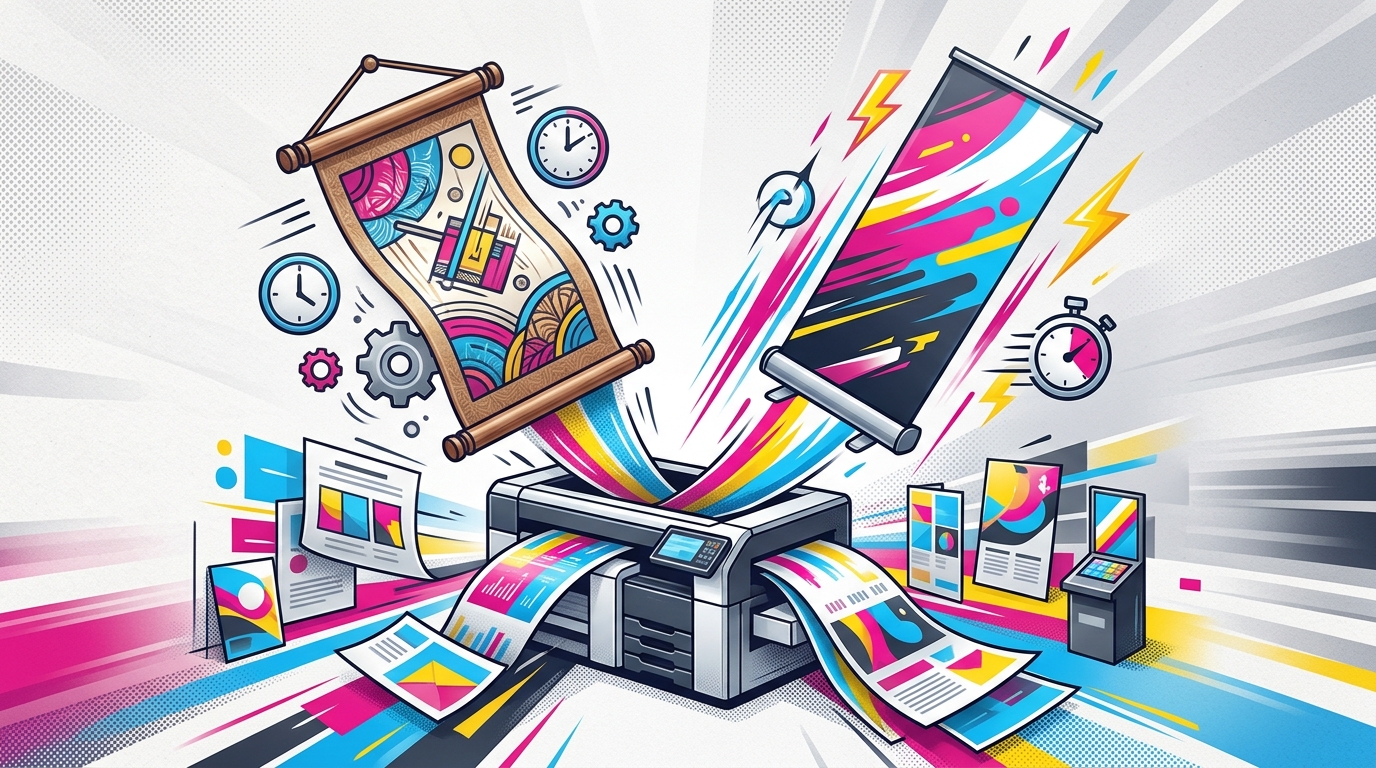
The simplest way to tell them apart can be summed up in one sentence: the roll-up is anchored to the floor and unfolds, while the kakemono is hung. They share the same goal of vertical visibility, but they’re set up differently and have different on-site requirements.
The roll-up banner (also known as a retractable banner) features a base with a mechanism that “retracts” the banner when it’s being stored. Setup on site is quick: just place it down, pull out the graphic, secure it to the pole—and you’re done. This is the “standalone” option, ideal when the team arrives on site with limited time and doesn’t want to negotiate a mounting point with the venue.
The kakemono is based on the concept of a stretched canvas, often held in place by profiles at the top and bottom, and then hung (on a wall, ceiling, structure, or grid). Visually, the result is very “light” and premium, especially when floor space is already limited. On the other hand, if no mounting points are provided, even the best print in the world won’t solve the problem: you’ll need to find a mounting solution, and that’s where scheduling can get complicated.
The right approach: Choose based on thedisplay location and logistics, not just on size. It’s the little details that save time… or waste a lot of it.
How the mounting really affects the final look and installation
A roll-up banner is stable, freestanding, and “ready to use.” It’s perfect for a trade show tour, multi-site meetings, or an event where the team needs to set up in just a few minutes. Real-world example: Lina arrives at 7:30 a.m. in Villepinte; the event opens at 9:00 a.m. Two roll-up stands, a QR code, a clear message: by 7:40 a.m., everything is set up, and no one had to look for a ladder.
A kakemono, on the other hand, can visually “float” above the booth, adding volume and height. In a shopping mall or showroom, it’s often more elegant than a floor-standing display. But hanging it requires a preliminary check (height, permits, existing mounting points). When the venue isn’t equipped, the display looks great… right in its box. Insight:Speed also depends on setup, not just on production.
Express production lead times: why the roll-up banner sometimes takes longer than the kakemono
In express production, the time required isn’t limited toprinting. You also have to factor in file preparation, drying and lamination (if applicable), cutting, finishing, and then assembly. And it’s often the assembly process that makes the difference between a 24-hour kakemono and a 24-hour roll-up.
The kakemono is mounted on a canvas and profile rails. The workshop prints on a tarp or flexible material, adds the specified finishes, and then inserts the canvas into the rails. It’s a fairly straightforward process, especially if the size is standard and the file is ready.
The roll-up banner involves an additional mechanism: the fabric must be perfectly sized, properly secured in the roller, and the tension must be just right. On some models, setup requires more handling. That’s also why roll-up banners can cost more: they involve mechanical components, added weight, and a more sophisticated “reusable” design.
Insight: When time is of the essence, an express kakemono often gets set up “faster” in the workshop… but an express roll-up banner often gets set up “faster” on-site. It’s up to you to decide where you want to save time.
The Workshop Steps That Make All the Difference in Rush Printing
When it comes torush printing, efficiency depends mainly on three factors. First, the file: the right format, proper bleed, sufficient images, and text that’s legible from 2 meters away (yes, that “elegant” 6-point font becomes a nightmare at a trade show). Next, the finishing: lamination, reinforcements, edge profiles, and die-cutting. Finally, approval: a proof approved quickly prevents reprints, and that’s the best possible way to save time.
Real-world example: For a product launch, Lina sends a graphic at 5:00 p.m. The file is clean, the margins are correct, and the bleed area for the roll-up banner is set up properly. Result: Express printing begins without back-and-forth, and delivery is the next morning. Same timeline, but the file is misaligned: the print shop has to call back, make corrections, and get approval. And the express service turns into “we’ll do our best.” Final insight: The print shop works quickly when the file is ready to go.
Which medium to choose based on use: trade show, retail location, showroom, corporate event
The choice depends primarily on how often it will be used and how portable it needs to be. If the display needs to be transported, set up and taken down frequently, and withstand trips in the trunk, the roll-up is a reliable choice. It protects the banner at its base, packs up quickly, and minimizes unpleasant surprises when unpacking.
If the goal is a more stationary, airier display with a graphic presence that leaves room to breathe on the floor, the kakemono is very effective. In a store, showroom, or exhibition, it can remain in place without blocking the walkway. The overall look is often more “gallery-like” than “tour booth.”
In crowded environments (with lots of floor-level point-of-sale displays, furniture, and display stands), the hanging kakemono has one advantage: it’s visible from a distance, without having to compete for 1 m² of carpet space. For a multi-site tour, the roll-up banner stays one step ahead: it doesn’t depend on a cooperative ceiling.
Insight: The best display is the one that fits your actual needs, not the one that “looks” the simplest in the catalog.
Real-world example: securing a booth two days before the event with express production
A classic scenario: the trade show is confirmed late, visuals are finalized at the last minute, and the team arrives the day before setup. Lina has to address two needs: a corporate message and a promotional offer. The corporate message is displayed on a hanging kakemono to add height and structure the space. The promotional offer is displayed on a roll-up banner so it can be moved according to visitor traffic (entrance in the morning, demonstration in the afternoon).
To avoid the “it’ll work” approach that never works, two checks will win the day: first, the correct safety zone for the graphic (especially on roll-up displays, where the bottom may be obscured depending on the model). Second, the actual mounting point for the kakemono (height, approval, and feasibility of installation). Final takeaway: When it comes to express printing, this method beats luck—every single day.
Express printer in the Île-de-France region: fast delivery and no unpleasant surprises
When deadlines are tight, the real value lies in the entire process: consulting, file review, production, finishing, and delivery to the right location. That’s exactly what prevents situations where “everything is ready… except the most important part.” When you need a roll-up banner in a hurry before leaving for or arriving at a site, a solution like express printing at Roissy ensures the success of events where every minute counts.
The same logic applies when setting up a consumer or trade show just before it opens: an event-focused organization—such as an express printing service in Villepinte—makes the difference between “set up on time” and “set up too late.” And if the project is taking place on the eastern side of Paris, rush printing in Montreuil allows you to quickly produce large-format materials that match your other booth elements.
The key point remains the same: the more urgent the request, the more important precision becomes. A clean file, a standard format, the right choice of media (vinyl, film, fabric), and quick approval: that’s the recipe for “managed urgency.” Final takeaway: when time is of the essence, we play it safe—and everyone breathes a little easier, including the booth team.
Do you have a project? No time to waste—let’s get started!